Tree Root Sewer Intrusion in Auburn AL Cary Woods Homes
Cary Woods is one of Auburn's most beloved neighborhoods, defined by its canopy of mature oaks, hickories, and sweetgums that arch over streets and sidewalks throughout the area. Those same trees that give Cary Woods its character are quietly threatening the sewer lines beneath the soil. Root intrusion is one of the most common and most damaging plumbing problems for homeowners in established Auburn neighborhoods, and Cary Woods properties sit at particularly high risk given the age of both the tree stock and the underground infrastructure. Understanding how this happens, what signs to watch for, and what your options are when roots have already entered a line can help you protect one of your home's most critical systems.
Why Tree Roots Target Sewer Lines
Roots grow toward water, warmth, and nutrients. Sewer lines deliver all three. Even a hairline fracture in a clay or cast iron pipe joint — the kind common in homes built across Cary Woods during the 1960s through the 1980s — releases water vapor into the surrounding soil. Roots sense that vapor and migrate toward it. Once a fine root tip penetrates the joint, it expands over time, feeding on the nutrient-rich wastewater inside the pipe. Left unchecked, what starts as a thread-thin intrusion becomes a dense root mass that restricts flow, catches debris, and eventually causes complete blockages or pipe collapse.
Auburn's climate makes this worse. During dry summers, soil moisture drops sharply, and roots extend farther and faster in search of water. The sewer line becomes one of the only reliable moisture sources in an otherwise parched yard. Dry spells in the Auburn area regularly push roots into joints that might have stayed sealed under wetter conditions. This is why many homeowners in Cary Woods first notice problems during or after a dry stretch — slow drains, gurgling toilets, or a backup that seems to come out of nowhere.
Intrusion Patterns Specific to Cary Woods
Not every yard presents the same risk. In Cary Woods, the layout of older lots means sewer laterals often run directly beneath or alongside large established trees. Many of the oaks in the neighborhood have root systems that extend well beyond their drip line, sometimes reaching 50 feet or more from the trunk. If your home was built in the 1970s and still has its original clay tile or cast iron lateral, there is a meaningful chance that roots have already found at least one joint along the run to the street.
The section of pipe most vulnerable is typically the lateral between your home's foundation and the municipal connection at the street. On many Cary Woods lots, this run crosses beneath the front yard, exactly where large shade trees were planted during original landscaping. The joints in clay tile pipe are particularly susceptible because they were sealed with oakum and mortar rather than modern rubber gaskets — materials that crack and gap over decades of soil movement and thermal expansion.
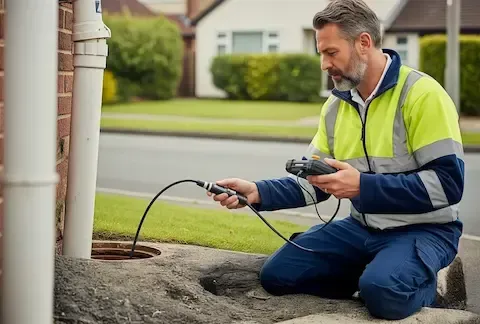
If you've experienced recurring slow drains or have had a main line snaked more than once in recent years, the underlying cause is almost certainly roots rather than grease or debris. Snaking clears the immediate blockage but does not address the intrusion point, which is why the problem keeps returning. For a clear picture of what's actually inside the pipe, the sewer camera inspection process is the most reliable diagnostic step before committing to any repair approach.
Cleaning Methods and Their Limitations
When roots have entered a sewer line, two primary mechanical options exist for clearing them: cable cutting and hydrojetting.
Cable cutting uses a rotating blade on a powered auger to cut through root masses inside the pipe. It's effective for restoring flow quickly and is often the first response to a blocked drain. The limitation is that it leaves root stubs inside the pipe and does not address the entry points. Roots regrow, often within six to eighteen months depending on the species and conditions. Recurring cable clearing is a management strategy, not a solution.
Hydrojetting uses high-pressure water to scour the pipe interior, cutting roots at the wall and flushing debris downstream. It's more thorough than cabling and leaves the pipe cleaner, but it still doesn't seal the intrusion points. For older pipes with multiple compromised joints, hydrojetting can also reveal pre-existing cracks by dislodging deteriorated sections.
In either case, a camera inspection after the cleaning tells you the true condition of the pipe — whether joints are still structurally intact, whether root regrowth will be a matter of months or years, and whether a more permanent repair is warranted.
Lining and Repair Options for Older Laterals
When root intrusion is severe or recurring, two main repair paths exist: pipe lining and pipe replacement.
Cured-in-place pipe lining, often called CIPP, involves inserting a resin-saturated liner into the existing pipe and curing it in place to form a smooth, jointless interior surface. This effectively seals every entry point along the lined section and eliminates the gaps that roots exploit. For Cary Woods homeowners who want to avoid excavating a front yard full of mature trees and landscaping, lining is often the preferred solution. The process typically requires access only at each end of the lined section, leaving the yard largely undisturbed.
Full pipe replacement is warranted when the existing pipe is too deteriorated to support a liner — collapsed sections, extensive cracking, or severe root damage that has compromised the pipe's structural integrity. In these cases, trenching is unavoidable. Given the tree coverage on many Cary Woods lots, a plumber experienced with local conditions can help you plan excavation routes that minimize damage to established roots and landscaping.
For ongoing protection after any repair, copper sulfate root treatments are sometimes used as a preventive measure. Applied correctly, they inhibit root growth near treated sections without harming the trees above. This is a maintenance tool rather than a cure and works best when the primary intrusion points have already been addressed through lining or repair.
When to Call a Professional
If you're dealing with slow drains that don't respond to normal clearing, recurring main line blockages, or water backing up into ground-floor fixtures, root intrusion should be your first suspicion — especially on a Cary Woods lot with mature trees anywhere near the sewer lateral path. Waiting typically makes the problem more expensive. Roots that are managed early with a combination of cleaning and lining cost significantly less than a full lateral replacement after a collapse.
Auburn Plumbing Pros works regularly in established Auburn neighborhoods, including Cary Woods, and understands the specific challenges older laterals and large tree canopies present. For expert diagnosis and repair tailored to your property, contact us about Sewer Line Repair and schedule a camera inspection to see exactly what's happening beneath your yard before deciding on the right course of action.
