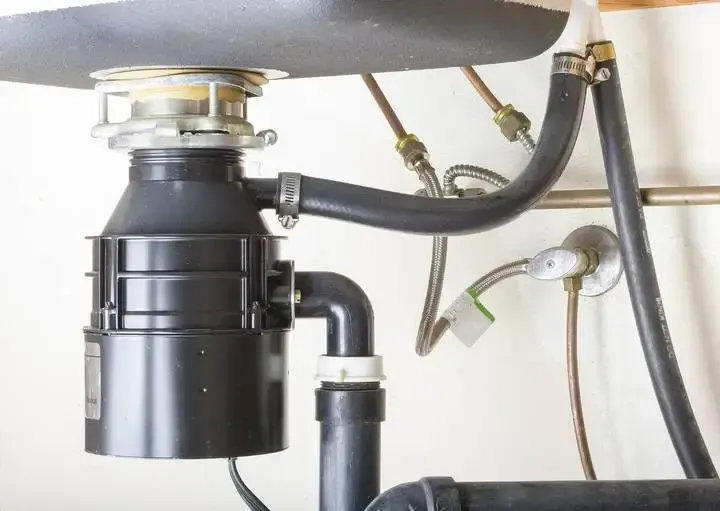
Garbage Disposal Humming but Not Spinning in Auburn AL
A garbage disposal that hums but won't spin almost always has a stuck flywheel — the rotating plate inside the unit that drives the grinding blades. In Auburn, AL homes, this happens most often after grinding fibrous vegetables, small bones, or built-up grease. The motor is receiving power and trying to run, but the flywheel is physically jammed. You can usually fix this in under ten minutes using the hex key (Allen wrench) that came with your disposal, without calling a plumber. If the reset does not work, the motor overload may have tripped or the disposal may need replacement.
Step 1: Kill the Power Before You Touch Anything
Reach under the sink and unplug the disposal from the outlet, or flip the dedicated breaker at your Auburn home's electrical panel. Never put your hand inside a disposal that has power connected, even if it appears completely dead. The motor can engage without warning. Once power is confirmed off, press the red overload reset button on the bottom of the unit — it may have popped out when the motor stalled. Push it firmly until you feel it click back in.
Step 2: Locate the Hex Socket on the Bottom of the Unit
Turn on a flashlight and look at the very center of the disposal's underside. You will see a small hex-shaped socket, typically sized for a quarter-inch Allen wrench. Most disposals ship with a small silver hex key taped to the unit or sitting in the original box. If you cannot find it, a standard quarter-inch Allen wrench from any Auburn hardware store — including the Lowe's on South College Street — will work on most InSinkErator and Waste King models.
Step 3: Work the Hex Key Back and Forth
Insert the hex key into the socket and turn it clockwise. If the flywheel is stuck, you will feel significant resistance. Do not force it. Work the wrench back and forth — a quarter turn clockwise, then back counterclockwise — applying steady pressure each direction. You are manually breaking loose whatever is jamming the grinding plate. Continue until you feel the flywheel rotate freely through a full circle. This usually takes thirty seconds to two minutes depending on how tightly the debris is wedged.
Step 4: Remove the Jam Material
Once the flywheel turns freely, use long-nose pliers or tongs to reach inside the disposal from the top and remove any visible debris — bone fragments, a broken utensil, a bottle cap, or compacted food material. Never use your fingers. Auburn Plumbing Pros sees a surprisingly high number of service calls caused by twist-off bottle caps that fell in unnoticed, especially in homes near Auburn University where kitchen use is heavy during football season.
Step 5: Restore Power and Test
Plug the unit back in or flip the breaker on. Run cold water into the sink — cold water keeps any residual grease solid so it flushes through rather than coating the drain line. Then press the wall switch. The disposal should spin up immediately and run quietly. If it hums again without spinning, the flywheel has re-jammed around remaining debris. Repeat Steps 3 and 4. If it makes no sound at all, the motor overload may need another moment to reset — wait ten minutes, press the red button again, and retry.
Step 6: Know When the Disposal Needs Professional Help
If you have completed the hex key reset two or three times and the disposal continues humming without spinning, the motor windings may be burned from the sustained stall. A disposal that smells like hot electrical insulation after the jam is a strong sign the motor is failing. At that point, Garbage Disposal Repair by a licensed Auburn plumber is the right call rather than continuing resets that can cause further damage. Units older than ten years are often more economical to replace than repair, particularly in Auburn's hard water conditions where internal corrosion accelerates wear.
For a broader look at what happens between a simple jam and a full unit replacement, read the garbage disposal jam to replacement walkthrough for a complete decision guide tailored to Auburn homeowners.
